

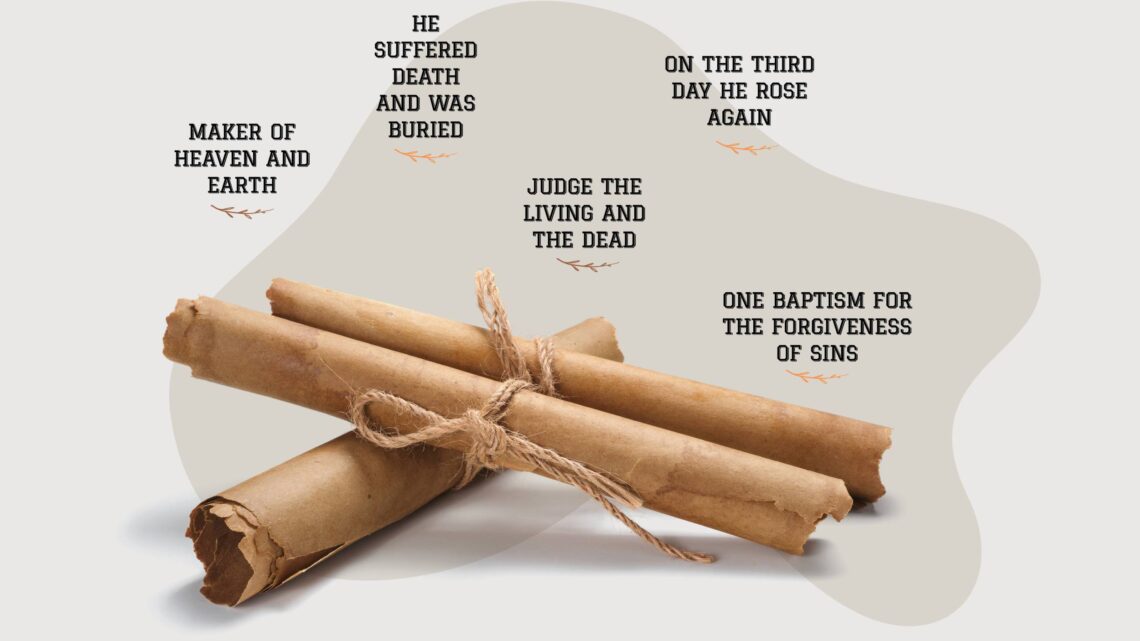
Last year, churches across the globe from both Eastern and Western traditions celebrated the 1,700th anniversary of the First Council of Nicaea held in 325 AD. Often described as the first ecumenical council, this assembly of bishops produced the Nicene Creed which continues to be regarded as the authoritative statement of Christian orthodoxy.
Sadly, however, some churches today do not think that creeds such as the Nicene Creed have any significance for the Church or individual Christians. Even those churches that give a nod to them seldom incorporate their recitation in the worship service.
There are many reasons for this. For some Churches and Christians (such as “non-creedal” Protestants), the normative authority of the Bible does not need to be supplemented by councils and creeds. For others, creeds are merely human creations—they tend to divide rather than unite the Church.
Here, John Wesley’s perspective and attitude to the tradition of the Church—the creeds and other theological and spiritual resources it offers—will prove instructive, especially for the people called Methodists.
That Wesley held Scripture in the highest regard cannot be doubted. Consider this marvellous statement which he penned in the Preface to the New Testament Notes:
The Scripture therefore of the Old and New Testament, is a most solid and precious system of divine truth. Every part thereof is worthy of God; and all together are one entire body, wherein is no defect, no excess. It is the fountain of heavenly wisdom, which they who are able to taste, prefer to all writings of men, however wise, or learned, or holy.
While Wesley has famously claimed to be a man of one book, he is also known as a voracious and eclectic reader, and someone who greatly respected the Christian tradition. For Wesley, the wholehearted embrace of the sixteenth century Reformers’ dictum of “Scripture alone” (sola Scriptura) does not mean disparaging or abandoning the great heritage of the Church.
Wesley of course did not regard the ecumenical Creeds as inspired in the same way that Scripture is inspired. However, he did recognise that the same Holy Spirit that transformed the words of Jeremiah and Paul into the word of God is also at work in the shaping of the Church’s tradition.
He believes that the composition of the Nicene Creed in the fourth century was somehow superintended by the Spirit, however convoluted and messy the process may have been. For it is the role of the Spirit to lead the Church into all truth (John 16:13–14), and the Spirit does this by providing clarity and ever-deeper insights into the inexhaustible revelation of God.
Wesley also read extensively the works of the early Fathers of the Church such as Ignatius, Tertullian, Polycarp, Irenaeus, Cyprian, Chrysostom, Basil, Ephrem and Macarius. The influence of these early Christian writers and theologians on Wesley’s understanding of salvation and the Christian life is evident.
Wesley regarded the works of the most eminent theologians of the Church as a resource and guide. They teach us how to read Scripture and provide us with the fundamental framework of orthodoxy within which it must be interpreted.
In an age where many Christians view creeds and doctrines as unnecessary or even divisive, Wesley’s own posture toward the Christian tradition surely provides a needed corrective.
How, then, can the contemporary Church recover the riches of its own Christian heritage? Here are some suggestions.
One of the most important ways in which Christians can be made aware of their own spiritual heritage is through the preaching and teaching ministry of the Church. Through sermons and teaching sessions, pastors and Church leaders can explore and expound the richness of the theological and spiritual traditions of the Church in light of Scripture.
Another approach is through the worship practices of the Church. Many evangelical churches have adopted a rather minimalistic approach to corporate worship, dispensing with many aspects that for many centuries were part of the liturgy of the Church.
Churches could reintroduce elements such as the historic Christian calendar and important feast days which are tied to major events in Church history such as Reformation Sunday. These simple measures can go a long way in creating awareness among members of the congregation of the rich heritage of which they are a part of.
Finally, churches could organise seminars where classical Christian texts such as Augustine’s Confessions and John Wesley’s Sermons are discussed. This will also help Christians perceive how their own spiritual lives are part of and in continuity with that of previous generations of believers and the Christian tradition itself.
Christians in the twenty-first century are recipients of the “faith that was once for all delivered to the saints” (Jude 1:3). It is a deep and life-giving faith that is rooted in the fertile soil of Scripture and divine revelation. It is a faith that offers inexhaustible spiritual wisdom and nourishment—a faith that all of us must receive, indwell and live by.
To neglect such a wonderfully rich spiritual heritage is simply to impoverish ourselves.
Dr Roland Chia is Chew Hock Hin Professor of Christian Doctrine at Trinity Theological College and Theological and Research Advisor at the Ethos Institute for Public Christianity.