


“We wanted to change the world and make a difference.”
That was the hope Halbert and Bong Yeo Louis, both 62, shared when they entered full-time ministry more than three decades ago. Over the next 20 years, the couple served in churches across Southeast Asia and started community programmes offering free healthcare, literacy support and mentoring to children and teenagers from at-risk families.
Today, making a difference takes a different form: helping a father manage his child’s behavioural issues, equipping a couple to navigate conflict or guiding parents to build stronger relationships with their children.
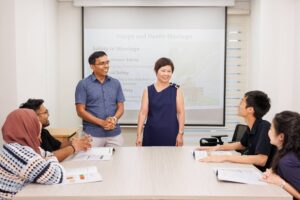
As Family Life Educators and Counsellors at Families for Life@Community (FFLC) – MWS, Halbert and Bong Yeo support couples and parents through marriage and parenting programmes and consultations, equipping them with practical skills to navigate challenges at different stages of family life.
Building connection before correction
For Bong Yeo, one such journey began with a father whose home had become increasingly tense. Both parents were juggling demanding jobs and raising two boys without a helper. Their younger son, in primary school, struggled to follow the daily schedule his father had set. Instructions often ended in tantrums and meltdowns; frustration turned to criticism.
Rather than give the father more rules to enforce, Bong Yeo encouraged him to focus on connection. “Look out for what your child is doing well, encourage him, spend time with him, hug him, and make him feel secure and safe,” she told him. “For every negative interaction with this child, you need to come up with two positive interactions.”
Within two weeks, the father noticed a difference. His son was following the schedule with far less fuss, and his wife remarked on how much the atmosphere at home had changed.
Halbert saw a similar dynamic with parents whose teenage son was struggling academically and spending excessive time on digital devices. Anger and nagging had come to dominate their interactions, with the father sometimes resorting to confiscating his son’s device.
“What you’re doing right now is, it’s you versus your son,” Halbert told them. “You’re not building a partnership.” He encouraged the parents to listen to their son and agree on expectations together. They introduced a behaviour contract linking a desired reward to milestones he could work towards. Two months later, the boy had gone from failing to doing well in his examinations.
For Halbert and Bong Yeo, both experiences reinforce a principle at the heart of their work: connection comes before correction. Just as important as connection is working upstream. “Our focus is always to lay a good foundation, be it in parenting or marriage—and part of that is addressing issues early, before they have a chance to fester,” Halbert said.
Giving and growing
Their own experiences as husband and wife and parents of two daughters also shape Halbert and Bong Yeo’s work. “We use a lot of our own examples—good and bad,” Bong Yeo said. “Sometimes, we share things we did that we shouldn’t have done as parents.”
When parents struggle with their teenagers, the couple share their own challenges raising their older daughter. As she entered adolescence, she began questioning why they still needed family devotions when they attended church and could read the Bible on their own. “During devotions, she’d be sitting there slouched and looking very disinterested. That would trigger us, and we’d either scold her or give her the cold shoulder,” Bong Yeo recalled.
For Halbert, her questioning initially felt like a challenge to his authority. “Eventually, I reached the point where I had to ask myself, is having a daughter who questions you bad or good? Actually, it’s good. She’s learning to discern and developing critical thinking,” he said. “I learnt not to be so dogmatic and to pick my battles.”
Rather than insist on the routine, they learnt to adjust and find other ways to connect with her—an experience they now share with parents to show how parenting approaches may need to evolve as children grow.
Yet for all their experience helping others, their work continues to teach them about their own relationship.
While preparing to facilitate a marriage programme last year, Bong Yeo encountered the concept of the “5 Languages of Apology”. It prompted her to revisit disagreements in her own marriage and consider why, despite apologies exchanged over three decades, some old hurts had never felt fully resolved.
“I realised that for me, just saying sorry is not enough,” she said. The discovery led Halbert and Bong Yeo to revisit a difficult period early in their marriage, when his struggle to set boundaries had left her feeling alone. “She needed me to acknowledge it, and when I did, it gave her some closure,” Halbert said.
Looking back, they recognise that some of their early struggles in marriage and parenting might have been avoided with what they know now. “We fought a lot, especially in our early years as parents,” Bong Yeo reflected. “That was where we realised that building a healthy marriage and parenting well are not a given,” Halbert added. “You need support and mentors to help you through. That led us into family life education.”
“More than 30 years ago, we wanted to change the world. Perhaps changing the world begins closer to home. Change one home, and you change a little piece of the world-one relationship, one family, one step at a time.”
To learn more about FFLC’s work, visit www.mws.sg. If you’re looking for a career where you can make a difference, explore opportunities at www.mws.sg/join-us.
By Methodist Welfare Services Communications Team. / Photos courtesy of Methodist Welfare Services